Virginia Woolf
English modernist writer and pioneer of stream of consciousness.

Adeline Virginia Woolf (25 January 1882 – 28 March 1941) was an English writer and one of the most influential 20th-century modernist authors. She helped to pioneer the use of stream of consciousness narration as a literary device. Born in South Kensington, London, into an affluent and intellectual family, she was the seventh child of Julia Prinsep Jackson and Leslie Stephen. Educated at home in English classics and Victorian literature, Woolf later attended King's College London, where she studied classics and history and encountered early advocates for women's rights and education. After her father's death in 1904, she moved with her siblings to the bohemian Bloomsbury district, becoming a founding member of the influential Bloomsbury Group. She married Leonard Woolf in 1912, and together they established the Hogarth Press in 1917, which published much of her work.
- born
- 25 January 1882, South Kensington, London
- died
- 28 March 1941
- field
- Literature
- nationality
- English
- known_for
- Stream of consciousness narration, novels Mrs Dalloway, To the Lighthouse, Orlan
Verified Timeline
Lore & Background
Virginia Woolf began publishing professionally in 1904 and rose to prominence during the interwar period with novels including Mrs Dalloway (1925), To the Lighthouse (1927), and Orlando (1928). She also wrote the influential feminist essay A Room of One's Own (1929), followed by Three Guineas (1938), which explores the roots of fascism in society. Her work became central to 1970s feminist criticism and remains influential worldwide, having been translated into more than 50 languages. Woolf's legacy endures through extensive scholarship, cultural portrayals, and tributes such as memorials, societies, and university buildings bearing her name. Woolf was born Adeline Virginia Stephen on 25 January 1882, in Hyde Park Gate, South Kensington, London. Her father was a writer, historian, essayist, biographer, and mountaineer; her mother was a noted philanthropist. Woolf's maternal relatives include Julia Margaret Cameron, a celebrated photographer, and Lady Henry Somerset, a campaigner for women's rights. Originally named after her aunt Adeline, Woolf did not use her first name due to her aunt's death in 1881. Virginia's great-nephew, the historian William Dalrymple, has claimed that Virginia was part Bengali through her maternal grandmother, Maria Theodosia Pattle. Both of Virginia's parents had children from previous marriages. Julia's first marriage produced three children: George, Stella, and Gerald. Leslie's first marriage resulted in one daughter, Laura. Leslie and Julia Stephen had four children together: Vanessa, Thoby, Virginia, and Adrian. Virginia showed an early affinity for writing. By the age of five, she was writing letters. From the age of 10, she began an illustrated family newspaper, the Hyde Park Gate News, chronicling life and events within the Stephen family, and modelled on the popular magazine Tit-Bits. Virginia would run the Hyde Park Gate News until 1895. In 1897, Virginia began her first diary, which she kept for the next twelve years. In the spring of 1882, Leslie rented a large white house in St Ives, Cornwall. The family spent three months each summer there for the first 13 years of Virginia's life. The happy summers spent at Talland House would later influence Woolf's novels Jacob's Room, To the Lighthouse and The Waves. Frequent guests included Henry James, George Meredith, and James Russell Lowell. The family did not return to Talland House after 1894; a hotel was constructed in front of the house which blocked the sea view, and Julia Stephen died in May the following year. In the 1939 essay 'A Sketch of the Past', Woolf first disclosed that she had experienced childhood sexual abuse by her half-brother, Gerald Duckworth. There is speculation that this contributed to her mental health issues later in life. There are also suggestions of sexual impropriety from George Duckworth during the period that he was caring for the Stephen sisters when they were teenagers. Her mother's death in 1895 precipitated what Virginia later identified as her first 'breakdown'—for months afterwards she was nervous and agitated, and she wrote very little for the subsequent two years. Stella Duckworth took on a parental role in the household. She married in April 1897 but died in July of that same year. After Stella's death, George Duckworth took on the role of head of the household. In February 1904 Leslie Stephen died, which caused Virginia to suffer another period of mental instability, lasting from April to September. During this time she experienced a severe psychological crisis, which led to at least one suicide attempt. Woolf later described the period between 1897 and 1904 as 'the seven unhappy years'. As was common at the time, Virginia's mother did not believe in formal education for her daughters. Instead, Virginia was educated in a piecemeal fashion by her parents. She also received piano lessons. Virginia had unrestricted access to her father's vast library. Beginning in 1897, Virginia received private tutoring in Classical Greek and Latin. One of her tutors was Clara Pater, while another, Janet Case, became a lasting friend and introduced her to the suffrage movement. Virginia also attended lectures at the King's College Ladies' Department. After their father's death, Vanessa and Adrian Stephen decided to sell their family home in South Kensington and move to Bloomsbury. Virginia lived in the house for brief periods in the autumn – she was sent away to Cambridge and Yorkshire for her health. She eventually settled there permanently in December 1904. From March 1905, the Stephens hosted gatherings with Thoby's intellectual friends at their home. This circle formed the core of the intellectual circle of writers and artists known as the Bloomsbury Group. Later, it would include John Maynard Keynes, Duncan Grant, E. M. Forster, Roger Fry, and David Garnett. The group went on to gain notoriety for the Dreadnought hoax, in which they posed as a royal Abyssinian entourage. Among them, Virginia assumed the role of Prince Mendax. During this period, Virginia began teaching evening classes on a voluntary basis at Morley College and continued intermittently for the next two years. She also made some money from reviews, including some published in church paper The Guardian and the National Review. Vanessa added another event to their calendar with the 'Friday Club', dedicated to the discussion of the fine arts. This gathering attracted some new members into their circle, including Henry Lamb, Gwen Darwin, and Katherine Laird ('Ka') Cox. Cox was to become Virginia's intimate friend. The Friday Club continued until 1912 or 1913. In the autumn of 1906, the siblings travelled to Greece and Turkey with Violet Dickinson. During the trip both Violet and Thoby contracted typhoid fever, which led to Thoby's death.
Reader's Guide
Virginia Woolf's significance lies in her innovative narrative techniques and her contributions to modernist literature. She helped pioneer stream of consciousness narration, a method that captures the flow of thoughts and sensations in characters' minds, as seen in works like Mrs Dalloway and To the Lighthouse. Her feminist essays, particularly A Room of One's Own and Three Guineas, argued for women's intellectual freedom and examined the societal roots of fascism, influencing later feminist criticism. Woolf's legacy endures through extensive scholarship, cultural portrayals, and tributes such as memorials, societies, and university buildings bearing her name. Her work has been translated into more than 50 languages, reflecting her global impact. The Bloomsbury Group, which she helped found, remains a subject of study for its influence on early 20th-century art, literature, and thought. Woolf began publishing professionally in 1904. She rose to prominence during the interwar period with novels including Mrs Dalloway (1925), To the Lighthouse (1927), and Orlando (1928). She also wrote the influential feminist essay A Room of One's Own (1929), followed by Three Guineas (1938). Her work became central to 1970s feminist criticism. She married Leonard Woolf in 1912, and together they established the Hogarth Press in 1917, which published much of her work. They split their time between London and Sussex, maintaining their involvement in literary circles throughout their lives.
Did You Know?
- Virginia Woolf was originally named Adeline Virginia Stephen, but she did not use her first name due to the death of her aunt Adeline in 1881.
- From the age of 10, Woolf ran an illustrated family newspaper called the Hyde Park Gate News, modelled on the popular magazine Tit-Bits, until 1895.
- Woolf's great-nephew, historian William Dalrymple, has claimed she was part Bengali through her maternal grandmother, Maria Theodosia Pattle.
- In the 1939 essay 'A Sketch of the Past', Woolf first disclosed childhood sexual abuse by her half-brother Gerald Duckworth.
- Woolf assumed the role of Prince Mendax in the Dreadnought hoax, where the Bloomsbury Group posed as a royal Abyssinian entourage.
The Fractured Self
Hume's philosophical argument that we never truly perceive a fixed self—that we only encounter a stream of particular perceptions like heat, cold, light, shade, love, hatred, pain, and pleasure—resonates powerfully in Woolf's fiction. In Mrs Dalloway and The Waves, the self is not presented as a stable, knowable entity but as something that slips away whenever we try to pin it down. Woolf's characters inhabit a world where identity is assembled moment by moment from sensory experience and emotional flux rather than from some metaphysical core. This de-centring of the self reflects a broader modernist impulse: the recognition that if we only know through the senses, then grand metaphysical claims about a unified, enduring "I" become untenable. Woolf's prose enacts this philosophical uncertainty, letting readers feel the self as subject rather than object, perpetually in motion, never quite catchable.
The Conscious Rupture
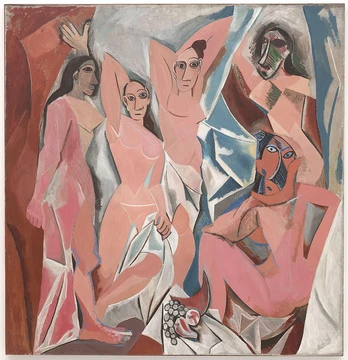
This was not a subtle revision of established techniques but a full severing from the conventions of nineteenth-century realism, which had tended to embed meaning within naturalistic, single-perspective representation. Modernist writers, Woolf included, sought to overturn traditional modes of storytelling and expression, driven by the imperative Ezra Pound crystallized in his call to make it new. The movement's intellectual roots stretched back to the 1880s, when thinkers began insisting that old norms needed to be pushed aside entirely rather than merely updated. For Woolf, this meant experimenting with literary form itself—abandoning the privileged single viewpoint in favor of something more uncentered, more multiperspectival, closer to what Picasso achieved in painting by synthesizing multiple views into a compound image. Her fiction rejects the assumption that one narrator's lens can capture the whole truth.
The Centre That Cannot Hold
A defining emotional current in Woolf's work—and in modernism more broadly—is the tension between yearning for metaphysical meaning and the knowledge that such meaning is ultimately unreachable. The image Yeats conjured of a world whose centre is dissolving captures this precisely. Modernist writers often search for some grounding truth about character, nature, or a higher order, only to watch that search collapse under its own weight. Woolf's novels participate in this restless oscillation: characters sense that a deeper significance lies beneath the surface of daily life, yet the narrative form itself undercuts any easy resolution. This distinguishes modernism from both its romantic predecessors, who sometimes treated symbols as transparent windows into divine language, and from later postmodernism, which celebrates the collapse rather than mourning it. For Woolf, the failure of symbol and metaphor is not a defeat to be mocked but a mystery to be inhabited—a perpetual, aching incompleteness at the heart of the human experience.
Minds in a New Century
Woolf's fiction emerged in a period when the immense human costs of the First World War forced a wholesale reassessment of prevailing social assumptions, and when technological and societal upheavals were reshaping what it meant to be human in the twentieth century. The intellectual climate was further shaped by the theories of Sigmund Freud and Ernst Mach, both of whom challenged straightforward accounts of consciousness and perception. Mach argued that the mind possesses a fundamental structure, complicating any simple picture of a transparent, rational subject. Freud's work added further layers of unconscious complexity to the inner life. For a writer like Woolf, these ideas provided fertile ground: the mind was no longer a clean, orderly chamber but a layered, often contradictory landscape. Her prose captures this new sensibility—the way perception is partial, the way the self is constructed from fragments, the way modernity's speed and disruption make older certainties feel inadequate. Woolf's work stands as a literary response to a world in which the old metaphysical scaffolding was crumbling and new ways of representing consciousness were urgently needed.
Frequently Asked Questions
Who is Virginia Woolf?
Virginia Woolf (1882–1941) was an English novelist, essayist, and a central figure of the modernist movement. She is best known for novels like Mrs Dalloway, To the Lighthouse, and Orlando, as well as her influential feminist writing.
What is stream of consciousness and how did Woolf use it?
Stream of consciousness is a narrative technique that renders a character's flowing, unfiltered inner thoughts rather than a strictly linear plot. Woolf helped bring this method to the forefront of English fiction, letting readers experience the private mental life of characters in real time.
What is A Room of One's Own about?
It is Woolf's 1929 extended essay arguing that women need both financial independence and a private space in order to write and create. The work has become a foundational text in feminist literary criticism.
Which novels are considered Woolf's masterpieces?
Her most frequently cited works include Mrs Dalloway (1925), To the Lighthouse (1927), and Orlando (1928). These novels are praised for their lyrical prose, psychological depth, and experimental treatment of time.
How did Virginia Woolf's life end?
On 28 March 1941, Woolf drowned herself in the River Ouse in Sussex, leaving a brief note to her husband Leonard. Her death has been widely discussed in relation to her long struggle with mental illness.
More in Modernist Prose Masters 1-21
Spotted an error? Know more?
This is a living reference — every entry is fact-audited, and reader corrections feed straight into our audit queue. Suggest an edit · See this site's audit record